East Bench Pivot Farm·Hay and Beef, East of Worland
A demonstration. This farm is invented, to show a Washakie County farm what a page of its own could look like. The county, the crops, the water and the rules are real, and every fact about them is sourced in the middle column.
What this is
A family farm on irrigated ground east of Worland, watered by a center pivot with the Bighorns in view. Alfalfa hay by the bale or the ton, certified weed-free for the mountains, and beef by the quarter, half or whole. Our sugar beets and malt barley go under contract to buyers in Worland.
hay · beef by the share · by appointment · call or text (307) 555-0142
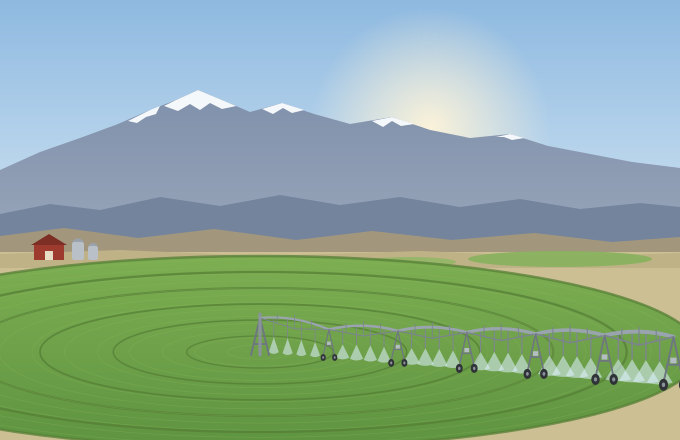
A sample illustration: the pivot on the east bench, the Bighorns behind.
Below is standard on every GYRO site
More Info
Uncheck anything you would rather not read
A Plain answers
What do you sell?
Alfalfa hay, and beef by the share. That is all we sell to the public.
Hay — alfalfa, in small squares you can lift by hand, and in 3x4 large squares by the ton. Certified weed-free when you ask for it.
Beef — a quarter, a half or a whole steer, once a year in the fall. You buy a share of the live animal, and the processor cuts it to your order.
Our sugar beets and malt barley are grown under contract and go to buyers in Worland910. They are not for sale here.
What does hay cost?
By the ton for large squares, by the bale for small ones. This season’s price for good alfalfa in 3x4 large squares is $285 a ton at the stack — a sample figure for this demonstration, set inside the range in the state’s own hay report: $270 to $300 a ton on 3 September 20262.
Small squares are priced by the bale. Delivery is extra; ask when you call.
Is your hay certified weed-free? Why does it matter?
Yes, when you ask for it. On the Bighorn National Forest, and every national forest in the region, you may not bring hay, straw or grain onto the forest unless it is certified weed-free and every bale carries the tag or twine that proves it3. Hunters, outfitters and anyone packing horses into the mountains need it.
Certified means the county Weed and Pest district inspected the field4. The paperwork comes with the hay; keep it with the bales.
How does buying a quarter of beef work?
You buy a share of the steer before it is butchered, in four steps.
You reserve a quarter, a half or a whole steer before it goes to the processor. You are buying a share of the live animal7.
We haul it to a custom-exempt processor in the Basin, and you tell the processor how you want it cut and wrapped.
You pay us by the pound of hanging weight — the carcass as it hangs after slaughter — and you pay the processor for the cutting and wrapping.
You pick up your beef at the processor, frozen and wrapped. The packages are stamped “Not for Sale”: they are for your household6.
You bring home less than the hanging weight, because of bone and trim. The processor can tell you what to expect from the way you ask for it to be cut.
Why can’t I just buy a steak from you?
Because Wyoming law does not allow it from a farm like ours. Meat from a custom-exempt plant may not be sold to stores or to anyone else; packaged cuts for sale have to come from an inspected plant5. What the law does allow is selling a share of the animal before it is butchered7, which is why we do it that way.
Where are you, and when can I come?
East of Worland, on the bench above the river, by appointment. Call or text first and we will send directions; we are often in the field.
Call or text (307) 555-0142. (A made-up number, from the 555-0100 to 555-0199 range set aside for examples like this one.)
Do you deliver?
Hay, yes: large squares by the truckload, anywhere in Washakie County. Small squares are loaded at the farm. Beef is picked up at the processor.
Why a website, and not just Facebook?
We are on Facebook too. It is good at reaching people who were not looking for us. But a post sinks. Last spring’s hay price is not corrected on Facebook, it is buried, and nobody can tell which post is still true.
This page holds still. This season’s price, what is available and how to reach us are always in the same place. No login to read it, nothing to scroll past.
This page is ours. On Facebook the farm wears Facebook’s name and colors and lives under Facebook’s rules, which Facebook can change. Here the name, the look, the words and the address all belong to the farm, the way the pivot does.
So our Facebook page points here, from its Website field, where the link stays put instead of sinking. Column C has the detail.
Who are you?
A family farm: two generations on the same irrigated ground east of Worland. Hay, beef, beets and barley, and one center pivot, which replaced years of flood irrigation from the ditch.
B Sources
Internal links
The two most recent content changes, and the record behind them.
Every reference to some other website, previewed. The link is always the last line — read the card first and decide whether you need the round-trip distraction of visiting the original at all.
1Statistics · county agriculture
2022 Census of Agriculture: Washakie County profile
USDA National Agricultural Statistics Service · released 2024 · public domain
206 farms on 368,504 acres, 38,025 of them irrigated. Hay and forage is the largest crop by acreage (20,022 acres), then barley (6,329) and sugar beets (5,298). The county runs 35,968 cattle and 28,744 sheep, and livestock brings in 55 percent of its $60.6 million in farm sales.
Why it is cited: it is the county this farm is invented to fit: irrigated hay, contract beets and barley, and cattle. Every crop on this page is among the county’s largest.
USDA Agricultural Marketing Service · Torrington, Wyoming · weekly or every two weeks
Prices paid for hay sold straight from Wyoming farms, by kind, grade and bale size. The issue of 3 September 2026 put good-grade alfalfa in 3x4 large squares at $270 to $300 a ton, with demand very good.
Why it is cited: the farm’s hay price is set against it, so a buyer can see the price is fair without taking the farm’s word for it.
USDA Forest Service, Rocky Mountain Region · in force 1 January 2025 to 31 December 2028
On every national forest in the region, the Bighorn among them, no one may possess, store or carry hay, straw, grain or other forage unless it is certified weed-free, with the certificate in hand and tags or twine on every bale. A violation is a Class B misdemeanor.
Why it is cited: it is why hunters, outfitters and horse packers heading into the Bighorns ask for certified hay by name.
Wyoming Weed & Pest Council · with the Wyoming Department of Agriculture’s Weed Free Forage Program
Wyoming certifies hay to the North American Weed Free Forage standards, which other western states accept too. The county Weed and Pest district does the field inspection.
Why it is cited: it is the inspection behind the farm’s certified bales, and the office a buyer can call to check.
Meat cut and wrapped in a state-inspected plant may be sold to stores or people anywhere in Wyoming, though not out of state. Meat from a custom-exempt plant may not be sold to stores or to anyone else.
Why it is cited: it is why the farm sells shares of a live steer rather than packages of beef.
Food Ventures in Wyoming: A Resource and Regulatory Guide
University of Wyoming Extension · bulletin B-1324 · 2018
Custom-exempt meat is marked “Not for Sale” and goes back to the animal’s owner. One steer can be sold as quarters to four different customers, with proper records. Selling across state lines takes federal inspection.
Why it is cited: it spells out, step by step, the quarter-and-half arrangement this farm uses.
Wyoming Statutes, Title 11, Chapter 49 · as published by Justia
Lets producers sell food they grow or make straight to the person who will eat it, but not meat, with narrow exceptions: poultry up to 1,000 birds a year, live animals, and portions of a live animal sold before slaughter for future delivery. A 2024 amendment for direct sales of uninspected beef takes effect only when the governor certifies that federal law allows it.
Why it is cited: it is the law that allows a share of a live animal to be sold at all.
Brand inspections are required whenever livestock change owners, and to move them across a county or state line. Animals sent straight to a sale barn or a slaughter plant are inspected when they arrive.
Why it is cited: it names the two times a Washakie County steer must be inspected: when it changes owners, and when it leaves the county.
The Worland factory was bought in 2002 by local growers, business owners, employees and citizens, who formed the Wyoming Sugar Company to keep it running. In 2018 it became a grower-owned cooperative, and it markets its sugar through United Sugars.
Why it is cited: the farm’s beets go to this factory under contract; they are not for sale here.
There’s Something In Wyoming That Makes It Perfect To Grow Coors’ Special Barley
Cowboy State Daily · 19 April 2025
Molson Coors contracts malt barley around Worland, including a variety of its own that only contract growers may plant. About 45 percent of the harvest goes to the company’s grain elevator about three miles outside Worland, and on by rail to a malt house.
Why it is cited: it describes the kind of contract the farm’s barley is grown under, and the elevator it goes to.
Highland Hanover Irrigation District Pump Station Replacement Project
U.S. Bureau of Reclamation, WaterSMART · 2023
The district’s own account of fields changed from flood irrigation to center pivots: from less than 50 percent efficient to more than 85 percent, done with NRCS EQIP and other program funding.
Why it is cited: it is the change this farm made, measured on real fields in the Big Horn Basin.
Conservation assistance to improve irrigation and conserve water
USDA Natural Resources Conservation Service, Wyoming · 16 November 2023
EQIP help for irrigation that saves water, in priority areas that include the Hanover Irrigation District area. The practices it covers include sprinkler irrigation systems.
Why it is cited: it is how a family farm pays for part of a pivot.
Chief Washakie FFA, the chapter at Worland High School, earned a Gold rating and was a finalist for Chapter of the Year. Ten Sleep FFA also earned Gold.
Why it is cited: these are the county’s FFA chapters. We are hoping they will want to act as ambassadors for pages like this one.
washakie-ai.online · a $10,000 proposal for grass-roots AI in Washakie County
A request to the Wyoming Business Council for a twelve-month pilot program in Washakie County: useful, practical websites made automatically for individuals and small businesses, yielding twelve working sites, four public workshops, and the method published free.
Why it is cited: a page like this one is what the pilot program would make. It is also the site one level up, linked from the card at the foot of this page.
gyro-sites.online · the GYRO website format, formerly Three Columns · an AI automation tool for generating ultralight one-topic websites
The format this page is built in: plain answers first, every source previewed in the middle, the full detail last. One page that works on any device, prints properly, and belongs to its owner.
Why it is cited: column C’s “About this page” says what the farm gets; this is the whole description.
Prior know-how is assumed here, and the items become more “technical” toward the bottom. The farm in detail: the ground, the water, the crops, and the rules behind every answer in column A.
The ground and the water
The farm sits at about 4,000 feet, in the driest part of Wyoming: the lower Big Horn Basin gets 7 to 8 inches of rain and snow a year13. Nothing here grows on rainfall alone. The water comes from the Big Horn River by canal, and Washakie County irrigates 38,025 acres that way1.
The pivot
The alfalfa is watered by a center pivot: a line of pipe on wheeled towers, turning slowly around a fixed point at the middle of the field where the water comes in, and dropping it close to the crop. Before the pivot, the field was flood-irrigated from the ditch.
The difference is large. In the Highland Hanover Irrigation District, fields changed from flood irrigation to pivots went from under 50 percent efficient to over 85 percent11, paid for in part through the Natural Resources Conservation Service’s EQIP program, which counts sprinkler systems in the Hanover area among its priorities12.
A pivot waters a circle, so the corners of a square field stay dry — the tan corners in the picture at the top of the page.
The rotation
Alfalfa stays in for several years; then the ground goes to sugar beets and malt barley before it returns to hay. Those are the county’s leading crops by acreage: hay and forage on 20,022 acres, barley on 6,329, sugar beets on 5,2981.
The beets go to the factory in Worland, bought by the community in 2002 and a grower-owned cooperative since 20189. The barley is grown under contract for malting and goes to the elevator a few miles outside town10. Neither is sold here.
The hay, in detail
Three cuttings in a good year, and each is tested for feed value; ask and we will send the report. Certified weed-free hay comes from fields the county Weed and Pest district has inspected; those bales carry the tags or twine, and come with the certificate, that the Forest Service asks to see34.
The price follows the market. The USDA’s Wyoming Direct Hay Report comes out every week or two from Torrington2, and the price in column A sits inside its range for the same kind and grade of hay.
The beef, in detail
A share has to be spoken for before slaughter, and that is what makes it legal. Wyoming lets a farm sell a live animal, or a portion of one, before slaughter for future delivery7, and one steer can go to four customers as quarters, with proper records6. What comes back is custom-exempt meat, marked “Not for Sale”: for the owner’s household, never for resale5.
The steer is brand-inspected, as the Livestock Board requires whenever livestock change owners or cross a county line8. A 2024 change to the Food Freedom Act would let farms sell uninspected beef directly, but it takes effect only when the governor certifies that federal law allows it7.
Who keeps this page
The farm does not build web pages, and does not have to. Behind this demonstration, we are hoping the county’s chapters of the Future Farmers of America — Chief Washakie FFA at Worland High School, and Ten Sleep FFA, both rated Gold in 202614 — will want to act as ambassadors: bringing pages like this one to the farms, and each farm’s news to its page. Whether they will be interested is not yet known. If they are, when the third cutting is in, the farm sends a text, and the card at the top of the middle column changes.
The pilot program that would pay for the first dozen pages like this one is proposed at washakie-ai.online15.
About this page
It is built in the GYRO format16: plain answers first, every source previewed in the middle, the detail last. It is a handful of plain files the farm owns outright — no monthly fee to a web company, no login for anyone who reads it, nothing to keep up but the words. It works on a phone in the pickup, and it prints properly for the kitchen table.
Like the best tool on the place: simple, rugged, and we, the farmers, own it.